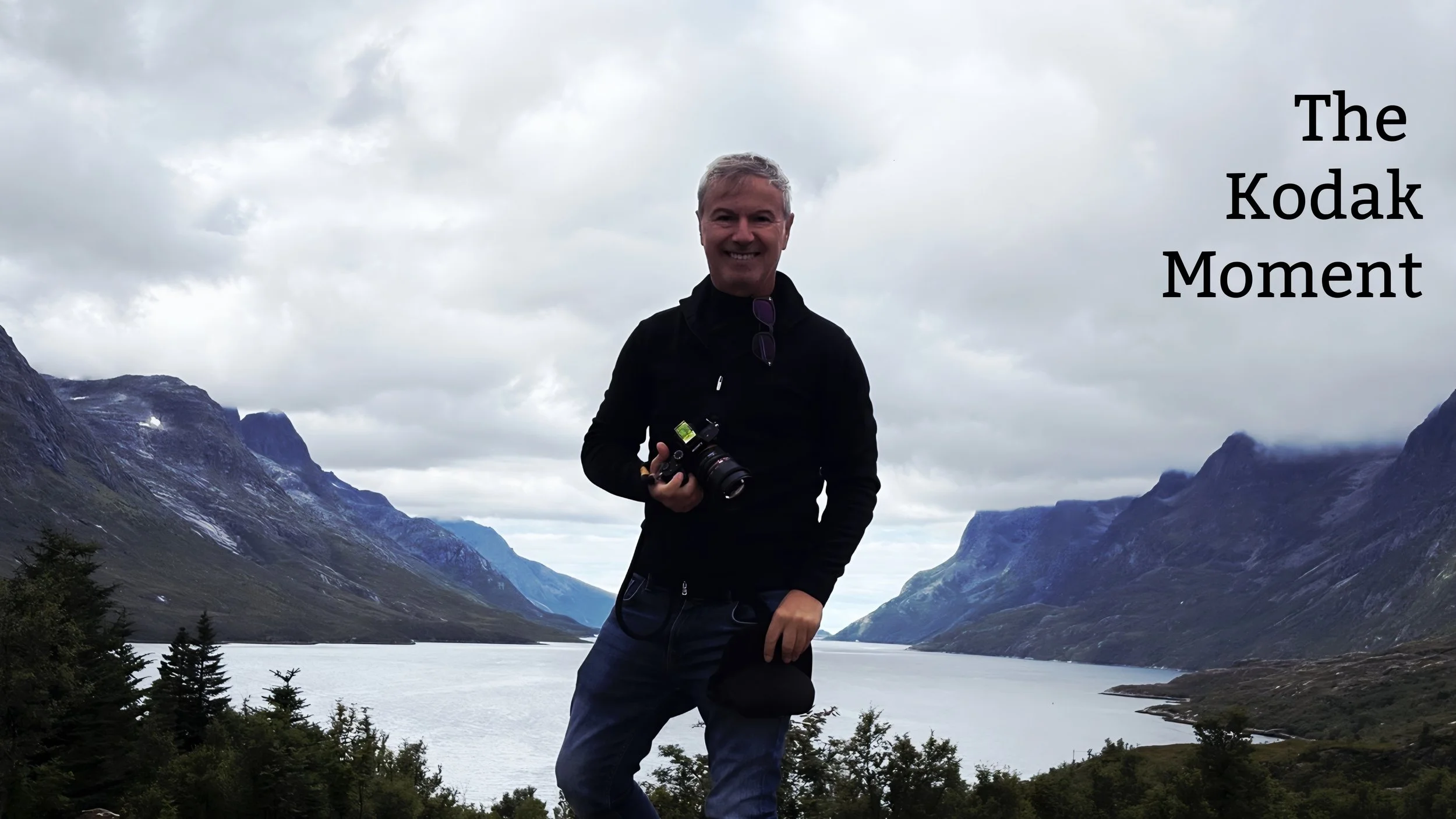
The Kodak Moment Story
I don't exactly know how I choose my themes, what triggers my thought process to say "write about this or that." I come across a lot of information, a lot of people, a lot of history, concepts, ideas, problems and processes. And yet, some are more "sticky" than others. Some remain in my subconscious longer, I think about them and their impact more, I wake up in the morning and have coffee with them, they fire up and some even enhance my imagination. In a cute little book, David Lynch compared ideas in the brain to a lake full of fish, where the subconscious goes fishing to catch the great ones. He even suggested transcendental meditation as a helpful practice, for people who need ideas rather than simply enjoy them. I enjoy ideas on a personal level, I live with ideas on a professional level. So in the last month I was about to write a thesis on the song "Driver's Seat" by Sniff 'n' the Tears, I was about to create a photo with a still life theme originating from a fifteenth century painting, and I was thinking about the case of Kodak. I imagine what is going on in my mind is what clinicians call "reminiscence therapy," where we pick up themes from our past and use them as an exercise for the brain. Anyway, I wrote about Kodak because it is a theme that goes back more than a hundred years, it has an intriguing story, an eccentric founder, a lot of corporate drama, and most of all, a fantastic slogan that remained alive for generations and changed meaning through the years, something extremely rare. In my line of business, successful slogans of this magnitude are unicorns and hence require respect and attention.
I came across the phrase "a Kodak moment" many years ago while watching CNBC. It had been a while since I'd last heard it used while someone was taking a photo, and then I heard it again recently, in Gen Z slang. So I decided to look a little deeper into this small phrase with such a rich history, and here is the short version of it.
A Kodak moment appeared as an advertising slogan in the 1970s, describing the instant a photo was taken. It became a household phrase and a huge success, helping establish the Eastman Kodak Corporation of Rochester, New York, even further. The real success came later, peaking in the mid 1990s, when the company held almost two thirds of the global camera film market, with one major rival, Fuji of Japan.
George Eastman founded the company before the turn of the century and ran it until his death in 1932. Several CEOs after him steered Kodak through the Great Depression, World War II, and the postwar expansion. Hollywood itself depended on Kodak film, and the company held a dominant share of that market for decades, controlling as much as 95% of the U.S. film market in 1976.
So what happened to this slogan, and why did it surface on a TV channel to describe a business situation?
In 1975, a young engineer named Steve Sasson built something in Kodak's own labs that would later help destroy the company. It was a camera the size of a toaster, weighing about four kilos, taking black and white photos and storing them onto a cassette tape. It took 23 seconds to save a single image. It was, in every sense, the first digital camera on Earth. Not long after, he demonstrated it to Kodak's executive committee, who famously said, "cute, but don't tell anyone about it." That moment was the precursor to Kodak's failure to survive, and who knows, it might even have become the leader in digital photography instead. The board preferred to protect the cash cow rather than invest heavily in the new technology. They missed big, just like Blockbuster, which Netflix offered to sell itself to for a fraction of its later worth, only to be laughed out of the room, or Nokia, which panicked and killed off its own product line overnight.
And this moment of utter failure, the moment you lose everything, the moment you're annihilated from the face of the earth, became a Kodak moment, shorthand for self inflicted, foreseeable collapse. The original slogan from the '70s found a new home, a new use, to describe a huge business failure.
None of the CEOs who presided over the company's free fall ever went public, or took to the speech circuit, to explain what happened. The only one who became "famous" was Steve Sasson, who spent years giving talks and telling the Kodak story, keeping the phrase "cute, but don't tell anyone about it" alive.
For the record, Fuji survived. Equally hit by the digital avalanche, it diversified early into skincare, medical imaging, and cosmetics, somehow figuring out that the same chemicals used to develop film could also beautify human skin.
Today, Kodak is a different, much smaller animal. It still exists, thanks partly to Hollywood directors like Nolan and Tarantino, and partly to Gen Z's love of vintage. The Kodak moment has resurfaced to describe a film loving Gen Zer who prefers film to digital, as a hobby and as a sophisticated aesthetic choice. The company makes only a fraction of the $16 billion it once earned in yearly sales, but the trend is in its favor. George Eastman's house in Rochester, New York, is now a museum, home to a rollercoaster story that reads like a bedtime business thriller.
Kodak died of denial, having correctly diagnosed its illness while refusing the medicine. But the slogan, dreamed up by an ad man in the '70s, is alive and kicking, survived its creator's bankruptcy, and found new uses along the way. What's ahead? I'd love to see it proliferate further, into more moments of disappearance, a striker threatening to give a goalkeeper a Kodak moment, or me, threatening to give the moussaka in front of me a Kodak moment before it's gone for good.